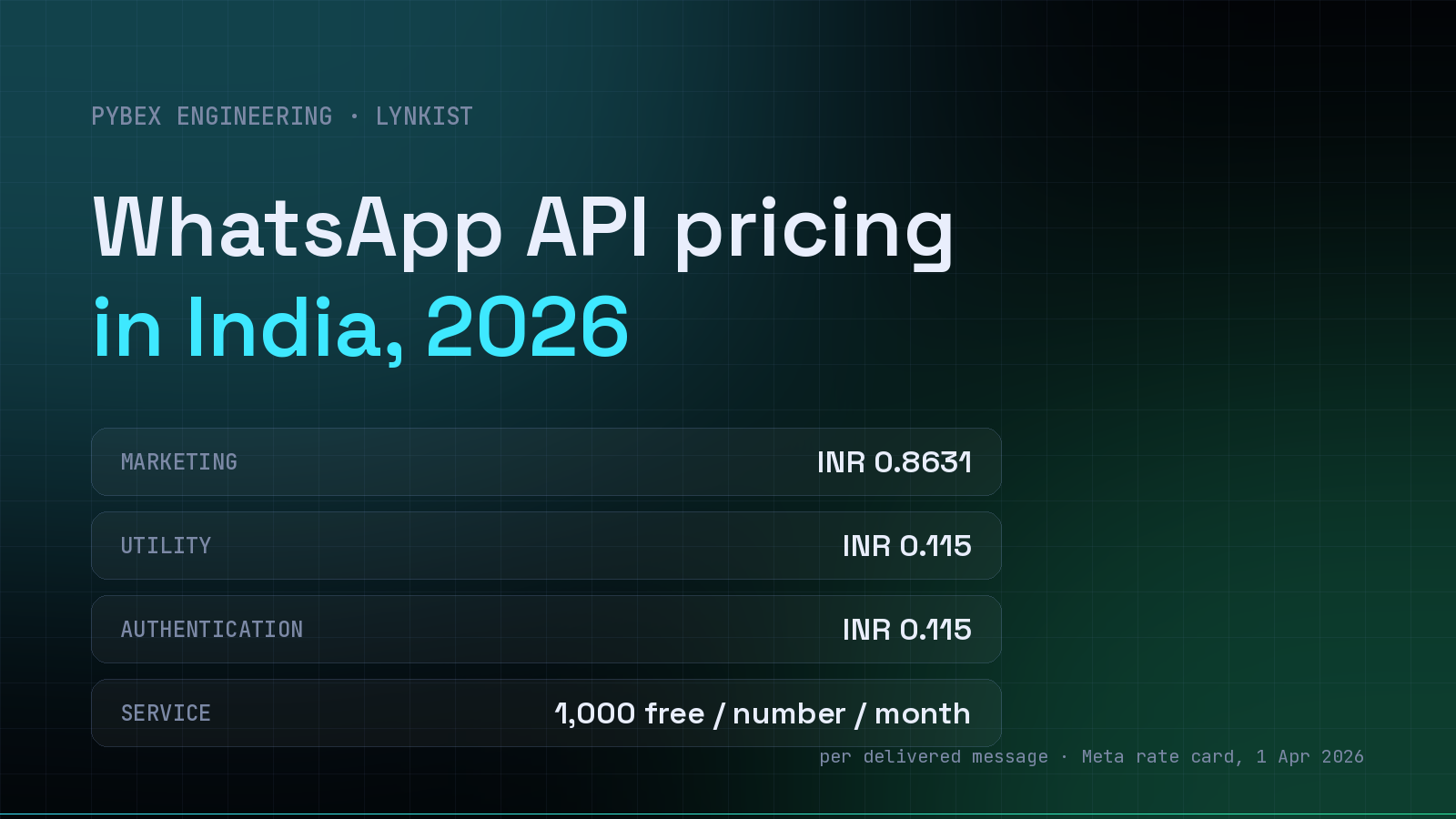
In short: in India, Meta charges ₹0.8631 for each delivered marketing message, ₹0.115 for each utility message and ₹0.115 for each authentication message (rate card effective 1 April 2026). Customer replies inside the 24-hour window are free up to 1,000 per business number each month, then ₹0.115 each. Everything a WhatsApp platform charges above these numbers is the platform's markup — and you can check it in two minutes.
We run Lynkist, a WhatsApp CRM that passes Meta's rates through at cost, so we read Meta's rate card every quarter. This guide explains what you actually pay per message in 2026, with worked examples you can copy into a spreadsheet.
How WhatsApp pricing works in 2026
Since 1 July 2025, Meta charges per delivered template message, not per 24-hour conversation. Three things set the price of a message:
- The template category — marketing, utility or authentication. Meta assigns the category when it approves your template.
- The recipient's country code — a message to a +91 number is charged at India's rate, wherever your business is.
- Whether a free window is open — some messages inside the customer service window, or after a click-to-WhatsApp ad, are free.
You pay only when a message is delivered. A message that fails does not cost anything.
Meta's rates for Indian numbers
| Category | What it is for | Price per delivered message |
|---|---|---|
| Marketing | Offers, launches, festive campaigns, re-engagement | ₹0.8631 |
| Utility | Order confirmations, shipping updates, payment reminders | ₹0.115 |
| Authentication | One-time passwords (OTPs) | ₹0.115 |
| Authentication — international | OTPs to Indian numbers from businesses outside India | ₹2.4971 |
| Service | Your replies inside the 24-hour window | 1,000 free per number per month, then ₹0.115 |
Source: Meta's INR rate card, effective 1 April 2026 — these are the rates Lynkist wallets are charged today. Meta's rates exclude taxes. Utility and authentication rates can drop further at high monthly volumes (Meta's volume tiers).
When messages are free
The 24-hour customer service window
When a customer messages you, a 24-hour customer service window opens. Inside it you can reply with normal messages — text, images, documents — without a template. Since 1 October 2026, each business number gets 1,000 of these replies free every calendar month; after that, each reply costs the Service rate (₹0.115). Utility templates sent inside the window are charged at the utility rate.
The 72-hour free entry point
When a customer reaches you from a click-to-WhatsApp ad or a Facebook Page call-to-action, a 72-hour free entry point window opens. Every message in that window is free — templates included — and these replies do not use your 1,000 Service allowance.
Messages customers send you
Inbound messages are always free.
Worked examples
Rates as above. Round to the paisa only at the end.
A festive campaign. 10,000 marketing messages delivered:
10,000 × ₹0.8631 = ₹8,631.
Order updates. 5,000 shipping updates sent outside the 24-hour window:
5,000 × ₹0.115 = ₹575.
Login OTPs. 2,000 authentication messages:
2,000 × ₹0.115 = ₹230.
A busy support month. 1,500 replies inside the window on one number:
the first 1,000 are free; 500 × ₹0.115 = ₹57.50.
The whole month together: ₹8,631 + ₹575 + ₹230 + ₹57.50 = ₹9,493.50 in Meta charges.
A rule of thumb: in India, one marketing message costs about the same as seven and a half utility or OTP messages (₹0.8631 ÷ ₹0.115 ≈ 7.5). Marketing is where your WhatsApp budget goes — and where a markup hurts most.
Where platforms add cost
Meta's rates are the floor. A platform can add cost in a few ways:
- A per-message markup — a fixed amount or a percentage on top of Meta's rate. For example, an extra ₹0.20 on each marketing message is a 23% markup; on the 10,000-message campaign above it adds ₹2,000.
- A separate "conversation" or "session" fee that Meta no longer charges.
- Prepaid credits that expire, or a minimum recharge larger than you need.
- Currency conversion when rates are quoted in US dollars but you pay in rupees.
None of these is wrong in itself — a platform has to earn money somewhere. The problem is when you cannot see it.
Five questions to ask any WhatsApp provider
- What do you charge per delivered marketing message to an Indian number? Is that exactly ₹0.8631?
- Do you charge anything on inbound messages or replies inside the 24-hour window?
- Do my prepaid credits expire? Is there a minimum recharge?
- Do you pass through the 1,000 free Service replies and the 72-hour free window after ads?
- Can I see a per-message ledger — what each message cost and why?
If a provider cannot answer the first question with a number, compare one invoice line against Meta's rate card above.
How Lynkist charges
Lynkist separates the two costs:
- Messages at 0% markup. Every message is charged from your wallet at exactly Meta's rate for that country and category, and the wallet ledger shows the cost of each message. Wallet top-ups carry a payment gateway fee, shown before you pay.
- The platform as a plan. The plan pays for the software — the shared inbox for WhatsApp and Website Chat, the AI agent, campaigns, Studio and the Android app. Plans start at ₹499 a month for Web Chat and ₹999 a month for WhatsApp (excluding GST), each with a 14-day free trial and no card needed.
The Lynkist dashboard also shows how many of your 1,000 free Service replies each number has left this month, and how many messages your wallet balance can still send.
Frequently asked questions
Is the WhatsApp Business API free in India?
No. Meta charges for template messages: ₹0.8631 per marketing message and ₹0.115 per utility or authentication message to Indian numbers. Replies inside the 24-hour window are free up to 1,000 per number per month, and inbound messages are always free.
How much does one WhatsApp marketing message cost in India?
₹0.8631 per delivered message on Meta's rate card effective 1 April 2026, before taxes and before any platform markup.
What is the difference between marketing and utility messages?
Utility messages are about a transaction the customer already started — an order, a booking, a payment. Marketing messages promote something. Meta decides the category when it approves the template, and a marketing message costs about 7.5 times a utility message in India.
Do I pay for messages that are not delivered?
No. Meta charges only for template messages that are delivered.
How often does Meta change WhatsApp prices?
Meta can change rates only on the first day of a quarter — 1 January, 1 April, 1 July or 1 October — and gives at least one month's notice for a rate change.
Can I keep using the WhatsApp Business app?
The WhatsApp Business app on your phone is free, but it has no API: no team inbox, no automation and no bulk campaigns. The pricing in this guide applies to the WhatsApp Business Platform (API), which tools like Lynkist use.
Rates checked on 19 November 2026 against Meta's INR rate card (effective 1 April 2026) and the WhatsApp Business Platform pricing documentation. Meta can update rates each quarter; we update this guide when it does.
Want to see your own numbers? Book a Lynkist demo — call or WhatsApp +91 84599 82986 — or start a 14-day free trial, no card needed.
Pybex engineers write about what they build and operate: Lynkist, SECRR, Krrim and client systems. Work with the team →